

Esther Jihye Cho: Silent Sufferings
performance stills, Common Wealth Gallery, Wisconsin, 2023


Silent Sufferings performance on May 5, 2023
Common Wealth Gallery, Wisconsin
photo by Jason Houge

installation view, Common Wealth Gallery, Wisconsin, 2024
pulp rocks, plastic bucket, water, hanji

exhibition installation documentation, Common Wealth Gallery, Wisconsin, 2023
video documentation by Aaron Granat
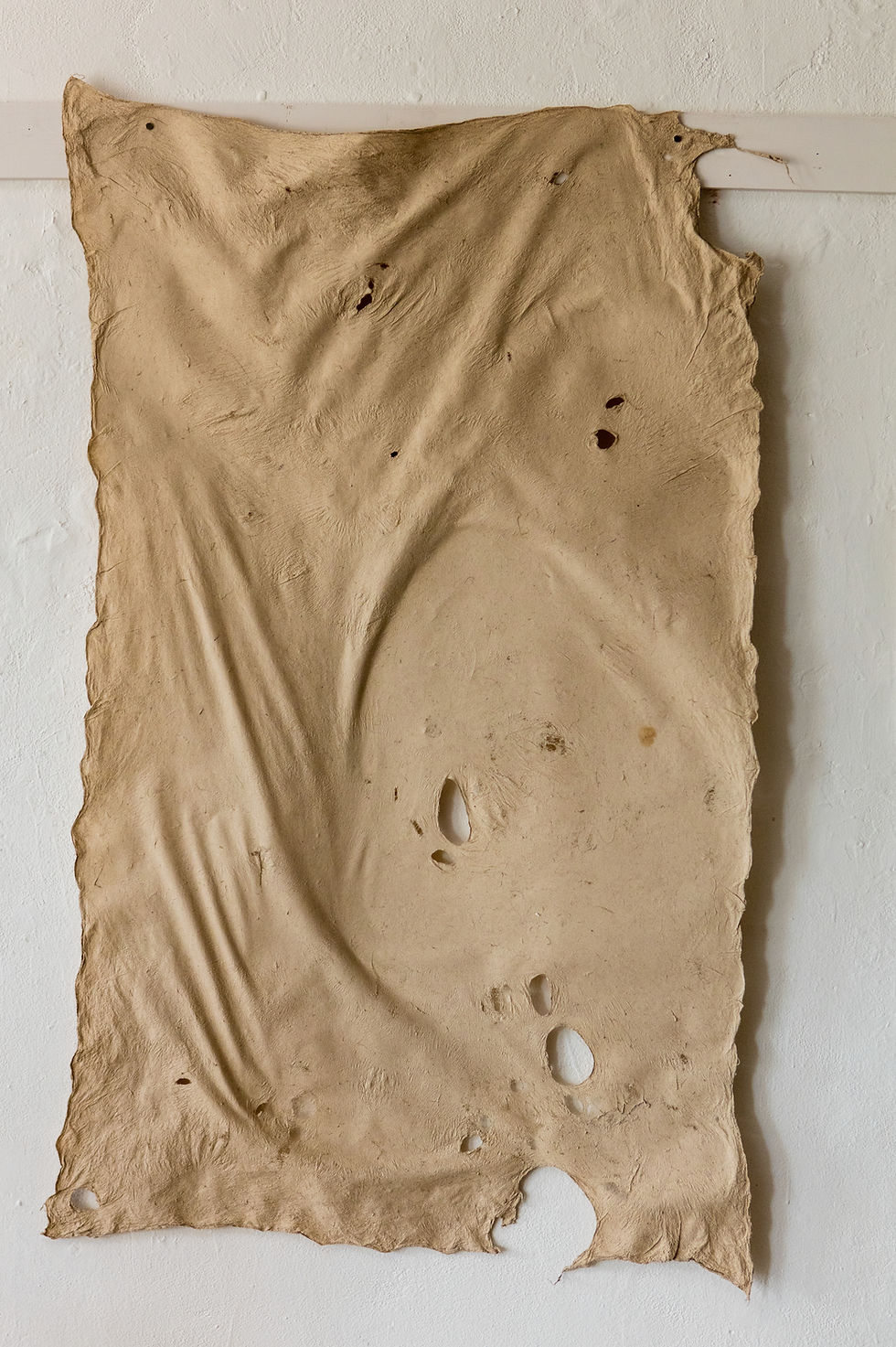
3 hours, 2023
joomchi, handmade mulberry paper by Nicholas Cladis
30.5"w x 60"h

2 hours, 2023
joomchi, handmade mulberry paper by Nicholas Cladis
30.5"w x 58"h

3 hours 30 minutes, 2023
joomchi, handmade mulberry paper by Nicholas Cladis
30"w x 57.5"h


Silent Sufferings performance, 2023
video by Aaron Granat
24 min 58 sec
"I repeated the same sequence of actions for two hours– wetting, folding, wiping, squeezing, washing, throwing, stretching, rubbing, kneading, tossing, pressing, and stepping."
Esther Jihye Cho: Between Memory
Silent Sufferings
May 2023
Common Wealth Gallery, Wisconsin
In the performance piece Silent Sufferings, I use my body as a tool to express femininity, portraying it as emotionally fraught, domestic, and intimate. Each action serves as a metaphor for emotional labor and the undervalued role of women, conveying a narrative without uttering a single word.
I'm intrigued by labor and the flow state it induces, where I lose track of time and effortlessly immerse myself in my craft. Joomchi, a traditional Korean papermaking technique, exemplifies this labor-intensive process, demanding hours of meticulous work. The technique involves using water to seal multiple layers of handmade mulberry paper to create a single strong sheet of textured paper. The method strains and demands on the hands and body, especially at a larger-than-human scale, taking several hours to create a single sheet successfully.
During this performance, I reveal my inner feelings and anxieties on womanhood. On the surface, it may appear as if I am doing laundry or cleaning the floors of the gallery, but beneath the surface lies a layer of loneliness and anxiety hidden from public view. Incorporating various actions such as wetting, folding, wiping, squeezing, washing, throwing, stretching, rubbing, kneading, tossing, pressing, and stepping, I immerse myself in my craft during the performance. Each action becomes a symbolic gesture, representing different aspects of my emotional journey and struggles with femininity and womanhood. Through these repetitive motions, I explore deeper into my inner feelings and anxieties, using the language of movement to express what words cannot convey.
With each gesture, I invite the viewers to witness and understand the depths of my experiences and concerns, creating a space of shared experiences and challenging the viewers’ understanding of womanhood and labor as prerequisites to social belonging and desirability.
Each performance concludes with the creation of a single sheet of textured paper, which is subsequently dried and displayed. These sheets serve as documentation of the performance itself, capturing remnants of the muddied water, traces of dirt from the gallery floors, unintentional entanglements of my hair, and impressions from my hands and feet. Upon drying, the paper reveals evidence of erosion and wear, with areas of negligence resulting in holes. As it dries, the paper takes on a leather-like quality, tightening during the process. I relinquish control over its drying and where it chooses to stretch and tighten, perhaps symbolizing my acceptance of the unpredictable nature of my own surroundings.
photos and videos by Jim Escalante, Aaron Granat, Jason Houge, and Veronica Pham.
Performance Reviewed by Veronica Pham
Esther Cho investigates how archiving, collection, and craft reflect the ways in which personal experiences derive from these individual modes of action. She playfully collects various nuanced materials, from her own hair to intangible repeated words, as well as stories of the past, present, and future. Archiving is a way for Cho to spark conversations that relate to time and culture, labor and craft, and more specifically, to her identity, which parallels her experience as both Korean and American. Cho works in sculpture, performance, and traditional Korean crafts to show how archiving—whether it be stories or materials—holds lost or invisible emotions that relate to our cultural lineage and our bodies.
In her performance piece, Silent Sufferings, she is situated in the center of the room, repeatedly making a large-scale piece using a technique called joomchi, a traditional Korean craft that utilizes large sheets of Korean paper known as hanji, felting them together to create a cloth-like material. She uses her entire weight, strength, hands, and body in a two-hour-long performance where the audience is unable to interact with her. The action that Cho demonstrates is both delicate and aggressive—a duality of emotions felt when watching the pieces come together in Cho's hands. Cho's quiet yet powerfully mesmerizing performance speaks to her own experience of how women endure labor, tension, and hold emotions that are often unseen or neglected.
In the performance, the audience may begin to question the tension that Cho endures as a Korean American woman and how she is mending and folding her experiences together. When Cho completes a joomchi piece, she hangs it up and proceeds to work on another. Each piece of fused paper resembles cloth, but they contain holes and areas of absence that occur during the felting process. If Cho's hands are too heavy, lace-like structures form within the sheet as holes. The pieces reveal the same quiet yet aggressive action demonstrated in the performance, capturing time and the present emotion. Each piece hangs like a collection and becomes an archive of her story, questioning the fragility of labor as a woman, Korean American, and practitioner of traditional craft.